
Praying stones
Have you ever been at а place where people pile rocks engraved with mystical messages which form miles long walls with no other function then getting closer to Enlightenment? A place where old men walk around holding sacred scrolls enclosed in metal cylinders and twiddle them endlessly. A place where people build white stone structures on every hill and peak in order to stop a daemon from throwing rocks on the passersby. A place where people upon entering a temple start lying down and then getting up multiple times or go around the said temple hours on end. A place where spiritual people enclose themselves in caves for years in order to stop the repetitive circle of reincarnation and ordinary people have, unthinkable for the western person, ideas like going around a mountain, lying down and getting up on every step which usually takes them several weeks. A place where people, without exception, go around objects or obstacles on their way always on the left because they think that if they go on the right an evil daemon could do them harm. A place where they bury people by cutting their corpses in parts and give the pieces to the vultures (a ritual known as “sky burial”).
If you have never been to such a place welcome to the lands of Vajrayana Buddhism.
Buddhism, the religion that originated in India before Christ, is one of the most popular religions in the world and the main religion in Asia. There is an argument whether it is religion at all or a philosophical system. The reason is that the Buddhist canon never speaks about a demiurge or any divine or supernatural forces. Respectively serving, bowing or divinization of any deity is not a requirement.
The founder of Buddhism known as Buddha Shakyamuni a.k.a. prince Siddhartha Gautama reaches certain internal realizations and tells the people that there is a way of liberating oneself from suffering. His insights are described as the Four Noble Truths and the way to liberation is synthesized in eight steps (The Eightfold Path) a.k.a. Middle Way.

Maitreya Buddha (the future Buddha)
The main goal in Buddhism is: to realize the root of all suffering that is in fact based in the human desires and all their forms; eradicate ignorance that impedes one from seeing the real illusory nature of the world. The sacred texts – the Sutra and the Shastra are thousands of pages with added comments and studies to them. Buddhism is a profound philosophic system that was further developed throughout centuries and in time got split into several dozens of regional sects that adopted very specific characteristics.
There are two main currents in Buddhism – Theravada Buddhism, known as The Lesser Vehicle or Hinayana. It is practiced in Southern India, Sri Lanka, Laos, Cambodia, Vietnam, Thailand, Burma etc. The most established characteristic is its focus on personal enlightenment.
The second is Mahayana Buddhism (The Greater Vehicle) is traditionally practiced in the North – Northern India, China, Japan, Korea, Nepal, and Bhutan. The focus here is on global enlightenment, once a soul is awakened the enlightened person has to come back in Samsara (the illusory world of cyclical life and death) and help the other sentient beings to free themselves from the cycle. Such a person is called Bodhisattva. We must add that every country has its own unique form of Buddhism based on the country’s specific culture, history and socio-psychological characteristics and of course neighboring countries always have many similarities.

Monks blow horns
Everyone knows Chan (Chinese) and Zen (Japanese) Buddhism that originated in China and later was transferred to Japan and Korea. It is considered to be part of Mahayana Buddhism, the same as the less popular Vajrayana Buddhism.
Vajrayana Buddhism (translated as the “Thunderbolt vehicle”) or Tibetan Buddhism is a unique and very different form of Buddhism. And though it originated from Mahayana, today is considered to be a different branch. It is practiced in Tibet, Bhutan and border regions of Nepal and India (Ladakh, Sikkim, Arunachal Pradesh).
According to historical sources in 12-th century the Indian mystic Padmasambhava brings Buddhism in Tibet. Before him the religion professed here is known as Bon and still has followers in some parts of Nepal and Bhutan. The most important thing in this religion are the daemonic forces and the ways of appeasing them as well as practicing black magic and sacrifices.

Monks dressed as daemons
It was hard for Padmasambhava to eradicate these practices and replace them with the pacifistic teachings of Buddhism. The end result was a syncretic, compromise mixture. The people here didn’t want to abandon their beliefs in daemons so Padmasambhava “shed light on them” so to say and made them protectors of the belief. Like this many elements transferred from Bon and mixed with the new teachings and the end result was Vajrayana Buddhism.
Even today in many Tibetan monasteries one can see and visit the so called Temple of the Protectors. Usually inside it there are big figures, with cloth over their faces, which make the visitor shudder. On the walls there are skillfully painted terrible daemons that have protuberant gigantic eyes and trample on people and tear their corpses. If one accidently looks at the bottom part of the image of the Wheel of Life, where hell is depicted, one can get nauseous.
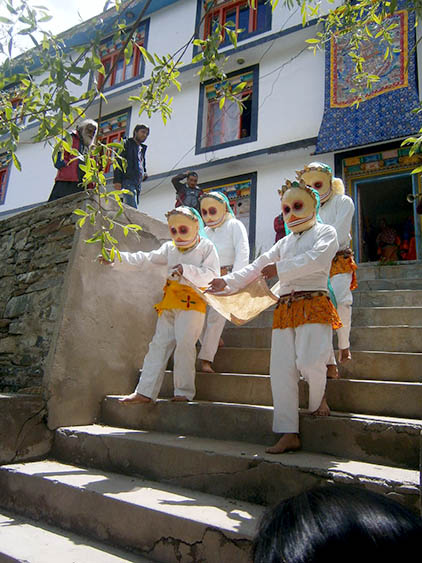
People dressed as skeletons at a festival
Remnants of Bon religion could also be noticed during the yearly festival which is celebrated on different dates in the different monasteries. The main event is the dance with the daemons where they are fought down and then liberated. Tibetan Buddhism incorporates many tantric, mystical and yoga practices that can’t be found in any other branch of Buddhism.
Some consider Tibetan Buddhism an animistic and superstitious religion while others think that the daemons and the magical practices represent heart-felt internal emotions with deep philosophical meaning. Regardless what we think of Tibetan Buddhism it molds the local culture and everyday life in the region and is without doubt a unique wealth.

Ritual dance
Historically Tibetan Buddhism has four major sects – Gelugpa, Kagyupa, Sakya and Nyingma. The creator of Gelugpa, a.k.a. The Yellow Hats is Tsongkhapa who was reformer-idealist and wanted Buddhism to go back to its roots from which it deviated away during the centuries. He tried to impose for monks to wear yellow robes (yellow is the color of renouncing the world according to Buddha) instead of the traditional red ones, but he managed to change only the color of their hats. The older sect Kagyupa or The Red Hats was never reformed and keeps the most traditional traits of Vajrayana till nowadays.
Other specific thing for Vajrayana is the phenomenon known as Lamaism. The Lamas, the spiritual persons and leaders of the community, participate in all the aspects of the social life of local communities. They participate in all births, weddings and funerals as well as in the leadership of all the monks’ establishments like monasteries, schools and academies.
The state and spiritual leadership was concentrated, before the Chinese invasion, solely in the hands of the highest Lama – Dalai Lama. Today the fourteenth Dalai Lama resides in exile at Dharamsala, India where he escaped from the Chinese Communist Party in the 50-s.
All spiritual leaders are chosen by a fascinating ritual. It is believed that every sentient being is reincarnated over and over and this is also valid for high Lamas. But since they are enlightened beings they always come back on Earth in human form in order to help others on their way to Enlightenment. Like this the first Lama, leading to the last one, the fourteenth, are in fact one person. Before he dies the Lama shows the whereabouts of his next reincarnation and after he dies a selected group of monks start searching for the newly born Dalai Lama.

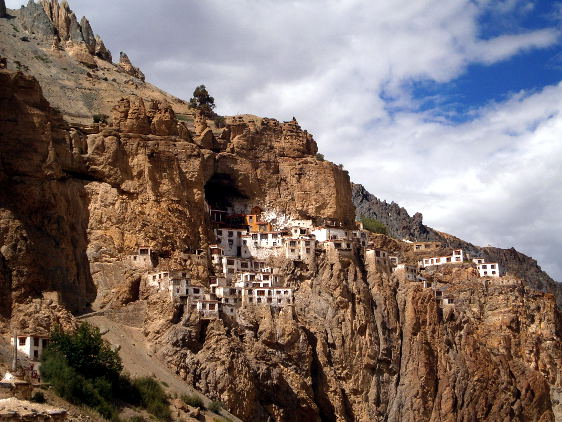
Hemis Monastery
When they find the child and he becomes 3-4 years old the monks give him a test: they show him some objects and if the child recognizes which ones of them belonged to Dalai Lama it means this boy is the new one. This practice had been followed for centuries, but the present Dalai Lama doesn’t want to reincarnate because of the political situation and probably this tradition will be discontinued.
Other established practices are: pilgrimage to Kailash Mountain and the sacred Mansarovar Lake; the ritual for spiritual initiation Kalchakra which is considered an esoteric secret, but has been conducted already dozens of times by the present Dalai Lama because of the high benefits for those who participate in it; long years of eremitism and meditation, etc.
In their everyday life Tibetans practice Sutra reading, prostrations (lying on the ground as a form of bowing and then getting up, then lying again which is repeated tens, hundreds and sometimes thousands of times). It is fascinating to watch a person who does prostrations. Usually they have cloth over their hands and knees which protects them from hurting themselves from the constant contact with the ground. Some monasteries even have special sliding wooden surfaces that facilitate the process. There are also pilgrims who go around Kailash Mountain with prosrations and it takes them months to pass the several hundred kilometers till they reach the place for the Kalchakra ritual, which is another important ceremony.
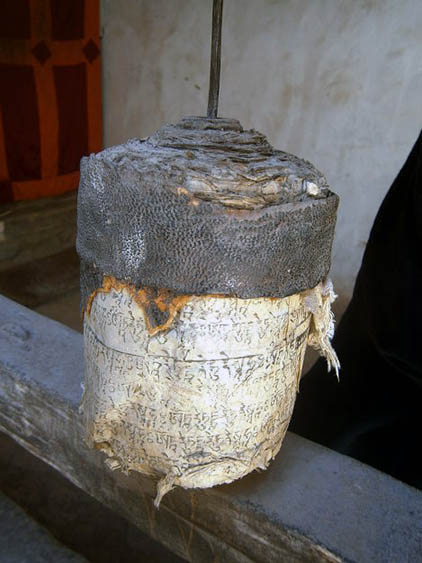
Ancient praying wheel
Often here one can see pilgrims who circle around a monastery or a temple with prostrations. The direction is always clockwise. Visiting sacred places is obligatory as well as saying mantras – 108 bean rosary, called mala, must be used or praying wheels which have the Sutra enrolled in them. Some praying wheels are several meters long while others are for personal use and can be carried in one’s hand. On the walls of the monasteries and temples are installed dozens of such wheels in rows and people spin them when they pass by them while going around the building.
Typical for Vajrayana Buddhism is the construction of mani walls – these are piles of thousands of rocks and usually those on the top are beautifully engraved with mantras or Sutra. These walls can be seen around every village temple and sometimes even in the mountains. Other widely built structures are the stupas – white, stone towers that sometimes contain the mortal remains of monks or lamas. There are thousands of them in the region.
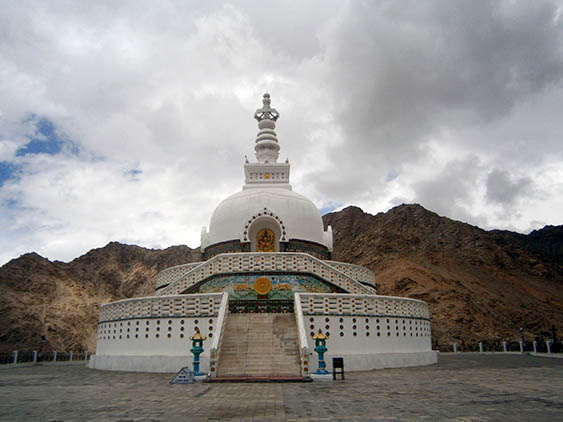
Shanti Stupa
When people turn the praying wheels it is considered that the following happens: on a higher level the idea is that the mantra is broadcasted in the ethers which helps with the enlightenment of all the sentient beings. On a personal level this guarantees good karma, better live in the next reincarnation and chasing away evil forces.
A religion which highest sacred saying is “Om mani padme hum” (translates as “The jewel in the lotus”) is no doubt something amazing that calls for more understanding and exploration.
If you are willing to breathe the thin air 13 000 feet above sea level, to shiver from the evening summer cold, to NOT eat a fruit or vegetable for days, to drink your tea with butter and salt, to forget the meaning of the words “shower” and “vegetation”, welcome to the lands of Vajrayana Buddhism and feel the magic of this irrational fairy-tale-like world.
N.B. Nowadays Tibet itself is not the best place to explore this culture for obvious reasons – it is territory of People’s Republic of China and if you go there even saying the words Dalai Lama can get you into trouble. The authenticity of the monks’ institutions is also questionable for the same reasons. But luckily there are always places like Ladakh, Nepal and Bhutan. So go ahead of globalization and lose yourselves in this traditional world for a short… or long time.
Author: MagicKervan
Notice: The article above is not pretending to be profound. The author is not specialist in Buddhism and the idea is to explain it in a simple way. The information in the article comes from observations and experience while travelling in Ladakh, India and Nepal.



 Magic Kervan